


















THE GREATEST INDIAN SCIENTIST SUBRAMANYAM CHANDRASHEKHAR
Mayank Dhawde, 6th
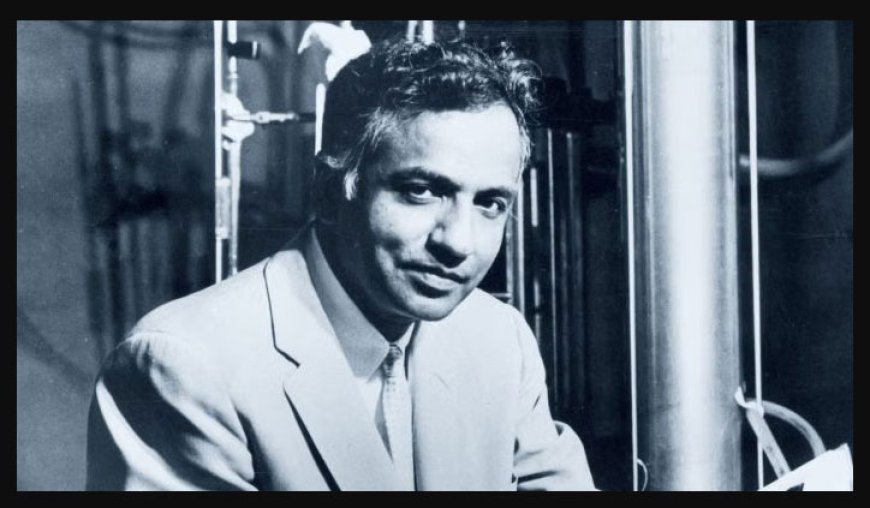
THE GREATEST INDIAN SCIENTIST SUBRAMANYAM CHANDRASHEKHAR
Mayank Dhawde, 6th
Born on October 19, 1910, Subrahmanyan Chandrasekhar was an Indian-American theoretical physicist who looked at the night sky and saw a mathematical puzzle. Though he spent his professional life in the United States, his journey into the stars began much earlier.
While traveling from India to England at the young age of 19, he began calculating the fate of dying stars. At the time, scientists believed all stars eventually cooled down and became "White Dwarfs." But "Chandra," as he was known, realized something groundbreaking: there was a limit to how heavy a White Dwarf could be.
Using the complex laws of relativity, he proved that if a star was more than 1.44 times the mass of our Sun, it could not remain a White Dwarf. Instead, it would collapse under its own gravity. This threshold is now famously known as the Chandrasekhar Limit.
His ideas were so revolutionary that they were initially mocked by the scientific establishment. However, Chandra remained patient and dedicated. Decades later, his work became the foundation of our understanding of black holes and stellar evolution. In 1983, he was finally awarded the Nobel Prize in Physics. Today, his name lives on not just in textbooks, but in the Chandrasekhar X-ray Observatory, a telescope orbiting Earth that continues to reveal the secrets of the universe he so loved.
